
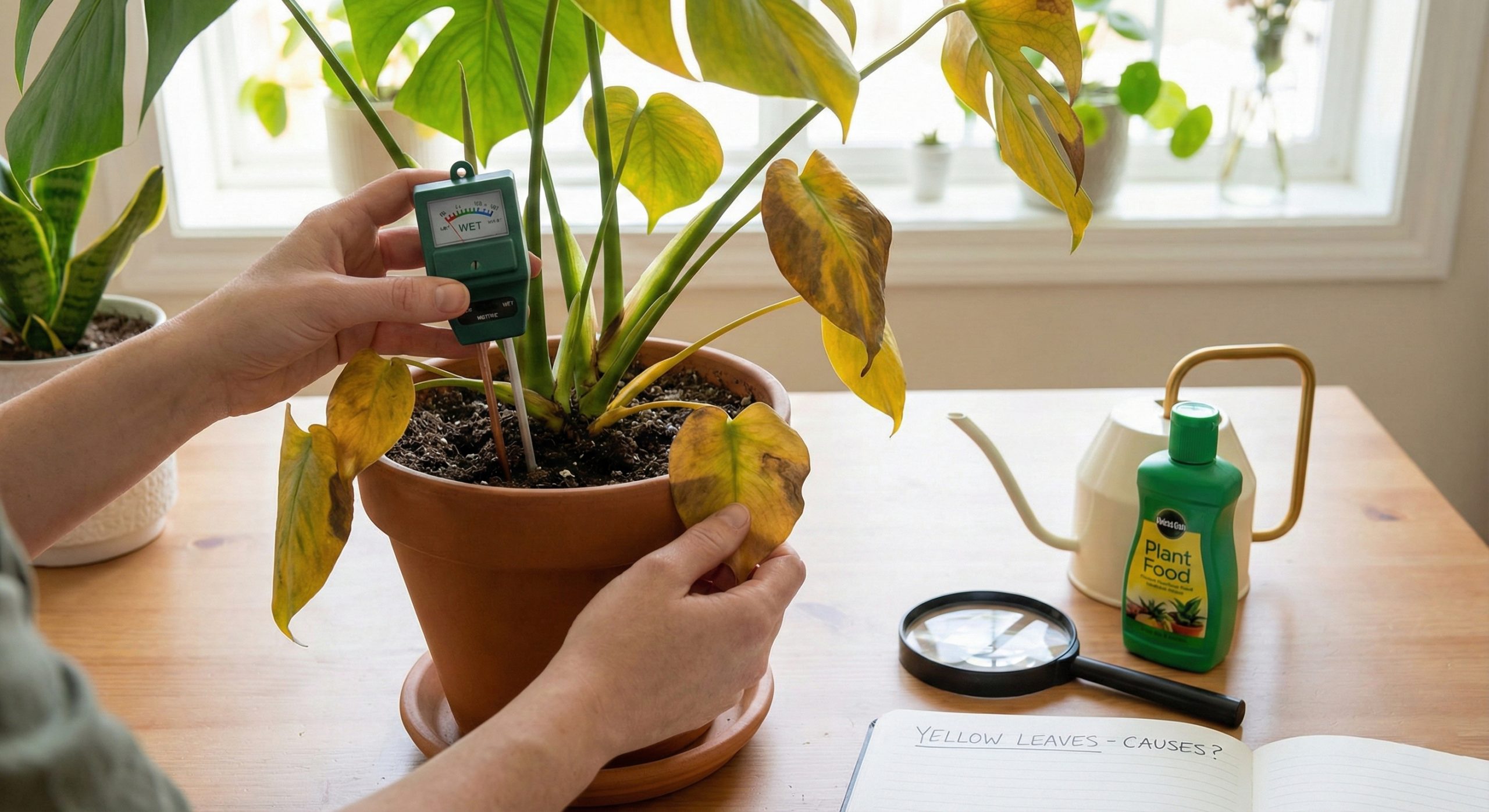
It’s the moment every plant parent dreads, leading to that frantic search for answers: “Why are my plant leaves turning yellow?”
You walk over to your thriving Pothos or Fiddle Leaf Fig, expecting green, only to find a sickly, bright yellow leaf staring back at you. First off, don’t panic. Yellow leaves (chlorosis) are just your plant’s way of communicating. It’s a distress signal, sure, but it’s rarely an instant death sentence.
While it can be confusing because “yellowing” is a symptom for opposite problems (like too much water and too little water), the plant usually leaves other clues to tell you exactly what’s wrong.
Here is the detective work required to figure out why your plant is turning yellow and how to get it back to green.
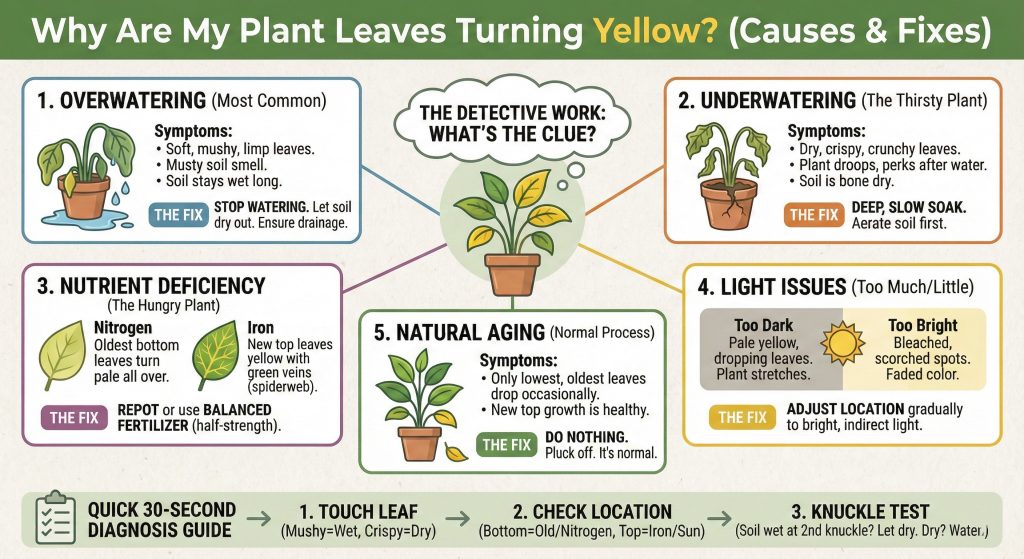
1. The “killing with kindness”: Overwatering
If we had to bet, this is your culprit. Most indoor plants die from too much love (water) rather than neglect.
Why it happens: Roots need oxygen just as much as they need water. When soil is constantly soggy, the roots suffocate and start to rot. If the roots are dying, they can’t send nutrients up to the leaves, and the leaves turn yellow.
The tell-tale signs:
- Texture is key: The yellow leaves usually feel soft, mushy, or limp.
- The sniff test: If you get close to the soil, it might smell musty or damp.
- The soil: It feels wet even days after you last watered it.
The Fix: Stop watering immediately. Check the drainage holes—is water trapped in the saucer? If the soil is dense and mud-like, you might need to repot with perlite or a chunkier mix to let it breathe.
2. The Thirsty Plant: Underwatering
On the flip side, if you’ve been forgetful, the plant will start sacrificing leaves to conserve moisture for the roots.
The tell-tale signs:
- Texture: Unlike overwatering, these yellow leaves will be dry, crispy, or crunchy to the touch.
- The droop: The whole plant usually looks sad and droopy, but perks up quickly after a drink.
- Soil: It’s pulling away from the edges of the pot and is bone dry.
The Fix: Don’t just dump a gallon of water on it at once. Aerate the soil (poke holes in it with a chopstick) so the water doesn’t just run off the sides, and give it a slow, deep soak until water runs out the bottom.
3. The “Hungry” Plant: Nutrient Deficiency
If your watering schedule is perfect, your plant might literally be starving. This usually happens if a plant has been in the same pot for years and has used up all the soil’s organic matter.
How to spot it:
- Nitrogen deficiency: Usually, the oldest leaves (at the bottom) turn pale or yellow first as the plant moves energy to new growth.
- Iron deficiency: This is distinct—the new leaves turn yellow, but the veins stay green. It looks like a spiderweb pattern.
The Fix: If it’s been a while, repotting with fresh soil is better than just adding fertilizer. If you do fertilize, use a balanced, water-soluble liquid fertilizer at half-strength to avoid shocking the plant.
4. Lighting Issues (Too much or too little)
Plants are goldilocks creatures; they hate extremes.
- Too Dark: If a plant isn’t getting enough light to photosynthesize, it can’t support all its foliage. It will slowly turn leaves yellow (usually starting from the bottom) and drop them to survive.
- Too Bright: If you moved a low-light plant into direct sun, the leaves will look “bleached” or scorched rather than a vibrant yellow.
The Fix: Move the plant. If you are moving it to a brighter spot, do it gradually over a week so it doesn’t get sunburned.
5. It’s Just Old Age (The “Do Nothing” Scenario)
Here is the good news: Sometimes, a yellow leaf is just… a leaf.
As plants grow, they naturally shed their oldest, lowest leaves to focus energy on new growth at the top. If your plant is pushing out healthy, green baby leaves at the top, but drops one single yellow leaf at the bottom every few months, this is normal.
The Fix: Pluck it off and thank it for its service. No chemicals or panic needed.
A 30-Second Diagnosis Guide
Before you pour anything on your plant, run through this mental checklist:
- Touch the leaf. Is it crispy (too dry) or mushy (too wet)?
- Check the “location.” Is it the bottom leaves (usually old age or nitrogen) or the new top leaves (usually iron or sun)?
- Use the “Knuckle Test.” Stick your finger into the soil up to your second knuckle.
- If it’s wet? Let it dry.
- If it’s dry? Water it.
Final Thoughts
Yellow leaves are annoying, but they are actionable. The trick is to avoid over-correcting. Don’t water, fertilize, and repot all in the same day. Identify the most likely cause (usually water), adjust that one thing, and give your plant a week to respond.